Category: Dr Kush Kanodia

  • ESB International responds to Curriculum and Assessment Review
    ESB International responds to Curriculum and Assessment Review

    ESB International responds to Curriculum and Assessment Review

  • National Momentum Builds for Oracy as The Guardian and Patrons of ESB International join Coalition Calling for Government Action 

    Education, equality and industry leaders unite to remind government of its oracy pledge.

    English Speaking Board (International) Ltd.’s (ESB International) patrons, Meena Kumari Wood and Dr Kush Kanodia, have joined the growing calls urging Prime Minister Keir Starmer to honour Labour’s 2023 pledge to embed oracy in the national curriculum.

    ESB International Patron:
    Meena Kumari Wood
    ESB International Patron:
    Dr Kush Kanodia

    Their voices add weight to a powerful open letter signed by Tina Renshaw CEO of ESB International along with 60 other Oracy champions, including children’s author Michael Rosen and former education secretaries Charles Clarke and Estelle Morris, calling on the new government to prioritise speaking and listening skills as a core educational entitlement. The letter, organised by Voice 21, frames oracy as the “fourth R” in education—alongside reading, writing and arithmetic—and urges the Labour government to deliver on its commitment to ensure every child develops strong communication skills to thrive in a world shaped by artificial intelligence, inequality and rapid social change. Their voices add weight to a powerful open letter signed by 60 leading figures, including children’s author Michael Rosen and former education secretaries Charles Clarke and Estelle Morris, calling on the new government to prioritise speaking and listening skills as a core educational entitlement.

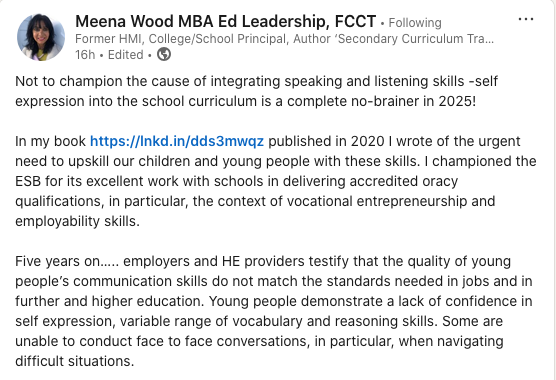
    A screenshot of Meena Wood's LinkedIn post

    The campaign for oracy has also received significant backing from The Guardian, which published a leader editorial on July 27 describing oracy education as a “low-cost, high-return” policy and stating that the new government “should seize the moment.” The editorial supports the open letter’s message and affirms that teaching young people to express themselves confidently and coherently is essential to a democratic society.

    In a separate column, Guardian journalist Simon Jenkins went further, writing that schools are “failing a generation” by neglecting public speaking. He describes oracy as “the very foundation of human interaction,” warning that an education system without structured speaking and debating leaves young people at a disadvantage not just in work, but in life. The founders of ESB International, Christabel Burniston MBE and Jocelyn Bell in 1953, identified that the power of human connection was central to their ideas about Oracy and the assessment of it. Their intention was to focus Oracy education on the interactivity of communication and the personal development it creates. That sense of personal agency and the development and enabling of authentic skilled voices continue s at the core of ESB International’s work today. 

    “A no brainer in 2025”

    Meena Kumari Wood, an educational consultant, trainer, author, Honorary Fellow in Educational Leadership (Univ. Birmingham), Board Member of Chartered College of Teaching and former HMI (Ofsted), Principal (Secondary), Academy Principal (Adult College) and LA Education Adviser, has described the omission of oracy from the government’s interim curriculum review as deeply concerning: 

    Not to champion the cause of integrating speaking and listening skills—self-expression—into the school curriculum is a complete no-brainer in 2025.

    Many young people demonstrate a lack of confidence in self-expression, possess a limited vocabulary, and struggle with face-to-face conversations—especially in difficult or professional contexts. Almost half of young people surveyed by CIPD in 2024 said they were never taught these essential skills at school.

    “Oracy is currency for life”

    ESB International’s Chief Executive, Tina Renshaw, a signatory of the open letter, has echoed Meena’s concerns and highlighted the practical contribution that ESB International’s unique qualifications can make to oracy education and on the employability skills of young people.

    ESB International CEO, Tina Renshaw

    As a vocational awarding organisation, ESB International recognises the valuable currency of oracy for life, work and study. Our most popular qualification among secondary schools is Speech for Employability, which builds confidence and competence in teamwork, business analysis, interview skills, and entrepreneurship. Oracy is not an optional extra, it is a foundation for success—and every child deserves access to it.

    “Will Labour Deliver?”

    Dr Kush Kanodia, an influential disability rights campaigner and social entrepreneur, emphasised that Labour’s promise to make oracy a central educational priority cannot be allowed to fade into the background:

    Will Keir Starmer honour the Labour Party pledge by embedding teaching oracy in the educational curriculum? This moment represents a once-in-a-generation opportunity to create a fairer, more inclusive system that empowers every child with the skills needed for life and work.


    Turning Promises into Policy

    The Oracy Education Commission recently described oracy as “a foundational building block” and warned that, in an age increasingly shaped by automation, communication skills are more valuable than ever. 

    As the full report of the government’s curriculum and assessment review approaches, ESB International fully endorses the words of the open letter: “We urge you to turn that promise into lasting change.”  

  • Week 4 of ESB’s ‘Oracy for All’ Campaign: Oracy for Independent Living and Social Interaction

    English Speaking Board (International) Ltd. (ESB) launches Week 4 of its ‘Oracy for All’ campaign, designed to reach out to, and empower more learners with significant learning needs through its ambitious and inclusive oracy qualifications.

    Oracy for Independent Living and Social Interaction

    • ‘Spoken language is crucial for successfully navigating social interactions and different cultural contexts. Strong oracy skills enable children and young people to express their feelings, advocate for their beliefs, and build and maintain healthy relationships.’ The National Literacy Trust quoted in the Oracy Education Commission’s 2024 Report

    Oracy Education Commission Evidence

    ‘59% of children say strong communication skills make them feel happier.’

    PEARSON SCHOOL REPORT, (written evidence to the OEC Commission 2024)

    ‘52% of parents say their children (aged 5-9 years old) are struggling to make friends because they lack self-confidence in speaking to others.’

    ESU POLLING, (written evidence to the OEC Commission 2024)


    At ESB, we provide communication-rich experiences that build confidence in every learner, empowering them to advocate for themselves and navigate daily life with self-assurance and independence.


    This week emphasises how strong communication skills are not only essential in the classroom, but also foundational to self-advocacy, autonomy, and fulfilling interactions in the community. For learners with significant learning needs, these skills are even more vital for everyday tasks and for forming and maintaining meaningful relationships.

    For over 10 years, ESB has provided specialist opportunities for learners with significant additional needs to succeed and this commitment is ongoing. We wholeheartedly believe that developing oral communication strategies is one of the keys to living an independent life. For those learners who experience challenges with communication, the priority is to develop their confidence when interacting with others, enabling them to deal effectively with the practicalities of daily life.

    Tina Renshaw, Chief Executive of English Speaking Board (International) Ltd.

    Our Qualifications

    ESB offers qualifications called Communication for Independent Living and Social Interaction, a part of our suite of Building Confidence in Communication oracy qualifications for learners with significant learning needs.

    As part of the qualification, learners will be able to:  

    • Section 1: Acknowledge or Respond to a greeting (Entry 1) / Communicate about living independently (Entry 2) 
    • Section 2: Answer Questions / Tell a group about something of personal interest (Entry 1) / Read a short text out loud (Entry 2) 
    • Section 3: Be part of an audience / Join a group activity (Entry 1) / Make a telephone call to the emergency services (Entry 2) 
    • Section 4: Respond to a farewell / Show support as a listener (Entry 1) / Support the communication of others in the group (Entry 2) 

    Adds Tina:

    Our group-based approach to assessment, seamlessly integrated into any curriculum, is designed to support learners to become more independent, enabling them to confidently engage in activities and social exchanges

    Belfast Met College, a long-standing partner of ESB, has witnessed the profound impact these qualifications have on their students with significant learning difficulties and disabilities.

    Belfast Met has had the honour of working with ESB and has witnessed first-hand the transformative impact that ESB qualifications have on individuals’ lives, supporting nearly 2,000 students with learning difficulties and disabilities. As a result, our students can now communicate independently, not just in the college setting, but also in their wider community.

    Belfast Met College

    Our Teacher Resources

    To support educators in fostering oracy skills in the classroom, ESB offers a comprehensive range of teacher resources, specifically designed to help isolate and practice effective speaking and listening skills.

    These resources include three groups of activities:

    • Everyday interaction
    • Giving a presentation
    • Fine-tuning the message

    These activities can be easily adapted for students working at various levels, ensuring that all learners can benefit from them. There are also various tips on inclusive practice in the classroom.


    Make ‘Oracy for All’ a Reality

    ESB’s ‘Oracy for All’ campaign underscores ESB’s mission to make life-changing communication skills accessible to every learner.

    To learn more about ESB’s qualifications, join our webinar on Tuesday the 26th of November at 4.00pm for an in-depth look at how these qualifications can make a real difference to the lives of individuals. 

    If you are unable to attend the webinar, you can reach out to ESB’s Business Strategy Team at business@esbuk.org for additional resources and information.

  • ESB launches Week 2 of its ‘Oracy for All’ Campaign: Enhancing educational outcomes

    English Speaking Board (International) Ltd. is excited to announce the second week of its ongoing campaign, “Oracy for All”. This week, we are focusing on the theme, “Oracy for School and Education”, highlighting the vital role of oracy in enhancing educational experiences and outcomes for all learners, particularly those with significant learning needs.

    Why Oracy Matters?

    A report by the Sutton Trust reveals that students who are articulate and can express themselves effectively, are more likely to pursue higher education and go on to secure professional employment. These verbal communication skills are critical for social mobility, emphasising how oracy can shape future opportunities.

    Over the past three years, ESB has collected and analysed data from Abbey Hill Academy and College, a special school located in Stoke on Trent, offering valuable insights into learner progress following the completion of ESB’s oracy qualifications.

    For learners measured against national curriculum statements for KS3:

    • 70% of learners improved their proficiency in two key areas:
    • Using Standard English confidently in a range of formal and informal contexts.
    • Enhancing their ability to use role, intonation, tone, volume, mood, silence, stillness, and action to add impact.
    • 65% of learners demonstrated improvements in speaking confidently, audibly, and fluently, with an additional 5% showing further significant progress.
    •  60% of learners showed improvement in participating in formal debates and/or discussions, summarising and building on what has been said, with 10% advancing even further.

    Tina Renshaw, ESB’s Chief Executive, says:

    In our commitment to unlocking potential through speaking and listening skills, we recognise that oracy is not just an add-on; it is an essential component of effective education. By developing these skills, we enable learners with significant learning needs to engage fully in their academic lives, enhancing their confidence and communication abilities. ESB’s assessment methodology provides real opportunity for learners to exert individual agency and learners feel more confident after completing their assessment.

    Oracy Teacher Resources designed specifically for learners with significant learning needs

    To support educators in fostering oracy skills in the classroom, ESB offers a comprehensive range of Teacher Resources, specifically designed to help isolate and practice effective speaking and listening skills. These resources include three groups of activities:

    • Everyday interaction
    • Giving a presentation
    • Fine-tuning the message

    These activities can be easily adapted for students working at various levels, ensuring that all learners can benefit from them. They can be adapted and differentiated for students working at different levels, and there are also some tips on inclusive practice in the classroom.

    Real Voices, Real Impact

    We have a long-standing relationship with English Speaking Board, and all of our students have the opportunity to take the assessment each year. At Aurora Foxes, our aim is to prepare all our students to be ‘work ready, life ready’ and English Speaking Board qualifications help us to achieve this.

    Mark Costello, Principal at Aurora Foxes Academy Somerset

    “ESB’s Oracy qualifications are extremely adaptable and inclusive, so every student, regardless of their starting point, obtains an opportunity to flourish. As educators, you can watch them pushing their limits and accomplishing things nobody ever thought possible.”

    ESB Assessor, Sunil Naphray


    Join the Conversation

    Are you an educator, parent, or SEND specialist eager to learn more about how oracy can make a difference in education? Click here to join us for an insightful webinar on Tuesday 26th November at 4:00 pm, where we will explore how ESB’s Oracy qualifications can significantly enhance learning outcomes for all learners.

    For more information about ESB’s qualifications and to register for the webinar, please click here. If you have any questions or enquiries, please feel free to reach out to our Business Strategy Team at business@esbuk.org.

    Together, let’s ensure every learner has the opportunity to develop essential oracy skills that will benefit them in the classroom and beyond.