Qualification Withdrawal Notice: L3 Award in Using Oral Skills for Interviews
Dear Centres,
Further to a review of our product portfolio, the following qualification will be withdrawn on 30th September 2026, due to low enrolments.
ESB Level 3 Award in Using Oral Skills for Interviews (501/0650/8)
If you wish to register your learners for an assessment this academic year, you must register before the 31st May 2026.
This is the Operational End Date.
Your learners can take their assessment after 31st May 2026 if they have been registered, but the last date for certificates to be issued is 30th September 2026. If you have any questions, or would like advice on other qualifications that we offer, please email product@esbuk.org
ESB International to Deliver Oracy Workshop with the English Association
ESB International is delighted to be partnering with The English Association to deliver a workshop on Thursday 21st May, led by ESB International’s Senior Assessor for Oracy. The session will explore how authentic speaking scenarios can support the explicit teaching of key communication skills in the primary classroom.
The session will focus on how teachers can create talk opportunities that feel relevant, realistic and reflective of learners’ real lives. By anchoring spoken language tasks in authentic contexts, learners gain greater agency in their communication and develop confidence, identity and stronger classroom relationships.
Oracy sits at the heart of ESB’s mission to build confident, effective communicators, and this workshop will offer practical guidance grounded in our long-standing expertise in spoken language assessment.
Exploring Authentic, Purposeful Classroom Talk
Drawing on examples from ESB’s Primary Oracy qualifications, the workshop will demonstrate how real‑life communication activities can be combined with the explicit teaching of discrete communication skills, including:
Voice
Structure
Pace and Pause
Gesture
Emphasis
Active Listening
These skills underpin effective communication and support progression in speaking and listening across the primary years.
Practical Ideas for Classroom Application
Participants will leave with a range of strategies for designing purposeful talk tasks that help pupils develop:
Confidence in sharing their ideas
Clarity in structuring and presenting information
Effectiveness as speakers and listeners
The session will also explore how classroom talk tasks can be thoughtfully sequenced to support ongoing development throughout a child’s primary journey.
Who Should Attend?
This webinar is designed for:
Primary school teachers
English subject leaders
Literacy coordinators
Trainee teachers and teacher educators
School leaders with an interest in oracy and spoken language development
By the end of the webinar, attendees will:
Understand what makes a classroom talk task meaningful and authentic
Know how to teach discrete communication skills through purposeful, real‑world speaking scenarios
Take away ideas for designing talk tasks that help pupils progress in speaking and listening across the primary years
Whether you are looking to strengthen your school’s oracy provision or seeking new approaches for encouraging confident communication, this workshop will offer practical insight and inspiration.
Book Your Place
We invite colleagues passionate about supporting pupils’ spoken language development to join us for this engaging and practical session.
ESB International responds to Curriculum and Assessment Review
English Speaking Board (International) Ltd. (ESB International) welcomes the publication of the Government’s Curriculum and Assessment Review and its recognition of oracy as speaking, listening and communication, encompassing verbal, non-verbal and alternative forms such as sign language and Alternative and Augmentative Communication (AAC).
ESB International has been an oracy leader since 1953 and we are thrilled to see the review’s position that oracy is a vital skill for learning, employment and life, as well as the review’s call for more coherence and guidance to support good practice across all phases of education, including post-16.
1. An Oracy Framework
The recommendation to introduce an oracy framework alongside those for reading and writing is a significant and positive step. At ESB International, we have consistently seen the benefits of structured opportunities for pupils to plan, practice, perform and reflect on their spoken communication. Our collaborative research with Whitgreave Primary School, published in the Chartered College of Teaching’s Impact journal, found measurable progress in learners’ confidence, prosody and active listening skills (amongst others) when oracy was taught and assessed in a deliberate way.
Our external assessment model was recognised by the Oracy All Party Parliamentary Group’s Speak for Change report (2021, pg. 43) as an established framework for oracy assessment. Our oracy qualifications, available from Early Years all the way through to adult learners and accredited at Level 1 and above, assess learners with consistency and fairness, while preserving the authenticity of live and varied communication, providing teachers and learners with impartial feedback while celebrating a wide range of strengths and styles. We welcome a future framework that recognises spoken language as equally significant to reading and writing, reflecting the principles that have long underpinned ESB International’s approach.
I think this has given them the chance to realise they do have knowledge… and what they have in their head is also just as important being spoken as it is written.
A quote from the lead teacher at Whitgreave Primary School
2. Oracy within 16-19 Education
The review also notes that current opportunities to develop communication, teamwork and leadership in the post-16 phase are uneven. We welcome this recognition. Strong spoken communication is central to learners’ confidence as they prepare for work, further study and independent living.
ESB International’s experience working with sixth forms and colleges shows that externally assessed communication qualifications can provide valuable evidence for the practical, interpersonal skills young people develop in this phase. ESB International’s Oracy assessments encourage reflection, dialogue and adaptability, skills identified in the review as increasingly important for future-proof employability. We believe that oracy offers a potentially game changing pathway for learners who struggle with traditional English resit pathways, with enjoyable assessments grounded in real-world communication and with a strong focus on employability.
Holly Lodge High School College of Science’s sixth form have been taking our Level 3 oracy assessments since 2021 with great success, qualifications that carry UCAS points.
We look forward to contributing to the wider conversation about how oracy can be meaningfully embedded within 16–19 routes, ensuring that all learners have opportunities to develop and demonstrate their critical thinking, leadership, and communication skills.
3. an Inclusive Understanding of Oracy
We are particularly pleased to see the review adopt an inclusive definition of oracy that recognises non-verbal communication, sign language and Alternative and Augmentative Communication (AAC). This definition reflects the diversity of learners’ voices and aligns with assessment approaches grounded in universal design, a principle long embodied by ESB’s qualifications.
We are passionate about enabling learners with a range of communication profiles to access oracy education and qualifications that reflect their strengths and their authentic voices. Our ‘Building Confidence in Communication’ suite of qualifications, for example, designed specifically for 16+ learners with significant learning needs offers adaptable pathways that recognise every form of communication as meaningful and valuable.
By embedding these inclusive principles across our wider portfolio, ESB shares the Review’s vision of ensuring that every learner regardless of background, ability or mode of communication has the opportunity to develop, demonstrate and be recognised for their voice.
Thank you to the Oracy Community
This moment belongs to a whole network of advocates, researchers and practitioners who have worked tirelessly to raise the status of oracy. We extend sincere thanks to:
The Review’s Chair, Professor Becky Francis CBE, the expert panel and contributors for foregrounding oracy in a world‑class curriculum, and to DfE for accepting the framework recommendation.
The Oracy APPG, its Chair Emma Hardy MP, its officers and all contributors who fed evidence into the final report.
Our founders Christabel Burniston MBE and Jocelyn Bell who in 1953 as innovators and educators created a form of Oracy assessment experience that was so valuable it has been able to bend and flex over that time as our society has changed and whose value today has been validated by the positioning of Oracy in this curriculum and assessment review.
The schools and colleges who have been innovators themselves and given children and young people an opportunity to have an Oracy education with ESB International.
Together, we can ensure that the framework becomes more than a document, that it lives in lessons, empowers every learner and strengthens the social fabric of our classrooms and communities. ESB International stands ready to support the development of the framework and offers its skills to the Department for Education.
Education, equality and industry leaders unite to remind government of its oracy pledge.
English Speaking Board (International) Ltd.’s (ESB International) patrons, Meena Kumari Wood and Dr Kush Kanodia, have joined the growing calls urging Prime Minister Keir Starmer to honour Labour’s 2023 pledge to embed oracy in the national curriculum.
ESB International Patron: Meena Kumari Wood
ESB International Patron: Dr Kush Kanodia
Their voices add weight to a powerful open letter signed by Tina Renshaw CEO of ESB International along with 60 other Oracy champions, including children’s author Michael Rosen and former education secretaries Charles Clarke and Estelle Morris, calling on the new government to prioritise speaking and listening skills as a core educational entitlement. The letter, organised by Voice 21, frames oracy as the “fourth R” in education—alongside reading, writing and arithmetic—and urges the Labour government to deliver on its commitment to ensure every child develops strong communication skills to thrive in a world shaped by artificial intelligence, inequality and rapid social change. Their voices add weight to a powerful open letter signed by 60 leading figures, including children’s author Michael Rosen and former education secretaries Charles Clarke and Estelle Morris, calling on the new government to prioritise speaking and listening skills as a core educational entitlement.
The campaign for oracy has also received significant backing from The Guardian, which published a leader editorial on July 27 describing oracy education as a “low-cost, high-return” policy and stating that the new government “should seize the moment.” The editorial supports the open letter’s message and affirms that teaching young people to express themselves confidently and coherently is essential to a democratic society.
In a separate column, Guardian journalist Simon Jenkins went further, writing that schools are “failing a generation” by neglecting public speaking. He describes oracy as “the very foundation of human interaction,” warning that an education system without structured speaking and debating leaves young people at a disadvantage not just in work, but in life. The founders of ESB International, Christabel Burniston MBE and Jocelyn Bell in 1953, identified that the power of human connection was central to their ideas about Oracy and the assessment of it. Their intention was to focus Oracy education on the interactivity of communication and the personal development it creates. That sense of personal agency and the development and enabling of authentic skilled voices continue s at the core of ESB International’s work today.
“A no brainer in 2025”
Meena Kumari Wood, an educational consultant, trainer, author, Honorary Fellow in Educational Leadership (Univ. Birmingham), Board Member of Chartered College of Teaching and former HMI (Ofsted), Principal (Secondary), Academy Principal (Adult College) and LA Education Adviser, has described the omission of oracy from the government’s interim curriculum review as deeply concerning:
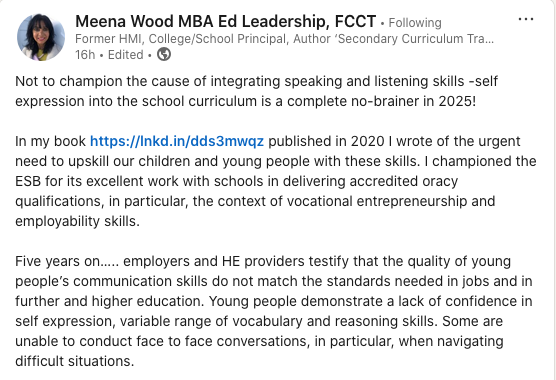
Not to champion the cause of integrating speaking and listening skills—self-expression—into the school curriculum is a complete no-brainer in 2025.
Many young people demonstrate a lack of confidence in self-expression, possess a limited vocabulary, and struggle with face-to-face conversations—especially in difficult or professional contexts. Almost half of young people surveyed by CIPD in 2024 said they were never taught these essential skills at school.
“Oracy is currency for life”
ESB International’s Chief Executive, Tina Renshaw, a signatory of the open letter, has echoed Meena’s concerns and highlighted the practical contribution that ESB International’s unique qualifications can make to oracy education and on the employability skills of young people.
ESB International CEO, Tina Renshaw
As a vocational awarding organisation, ESB International recognises the valuable currency of oracy for life, work and study. Our most popular qualification among secondary schools is Speech for Employability, which builds confidence and competence in teamwork, business analysis, interview skills, and entrepreneurship. Oracy is not an optional extra, it is a foundation for success—and every child deserves access to it.
“Will Labour Deliver?”
Dr Kush Kanodia, an influential disability rights campaigner and social entrepreneur, emphasised that Labour’s promise to make oracy a central educational priority cannot be allowed to fade into the background:
Will Keir Starmer honour the Labour Party pledge by embedding teaching oracy in the educational curriculum? This moment represents a once-in-a-generation opportunity to create a fairer, more inclusive system that empowers every child with the skills needed for life and work.
Turning Promises into Policy
The Oracy Education Commission recently described oracy as “a foundational building block” and warned that, in an age increasingly shaped by automation, communication skills are more valuable than ever.
As the full report of the government’s curriculum and assessment review approaches, ESB International fully endorses the words of the open letter: “We urge you to turn that promise into lasting change.”