English Speaking Board (International) Ltd

Category: Speech

  • Great Oracy Exhibition 2026 | ESB International

    Great Oracy Exhibition 2026 | ESB International

    Oracy takes centre stage at The Great Oracy Exhibition 2026
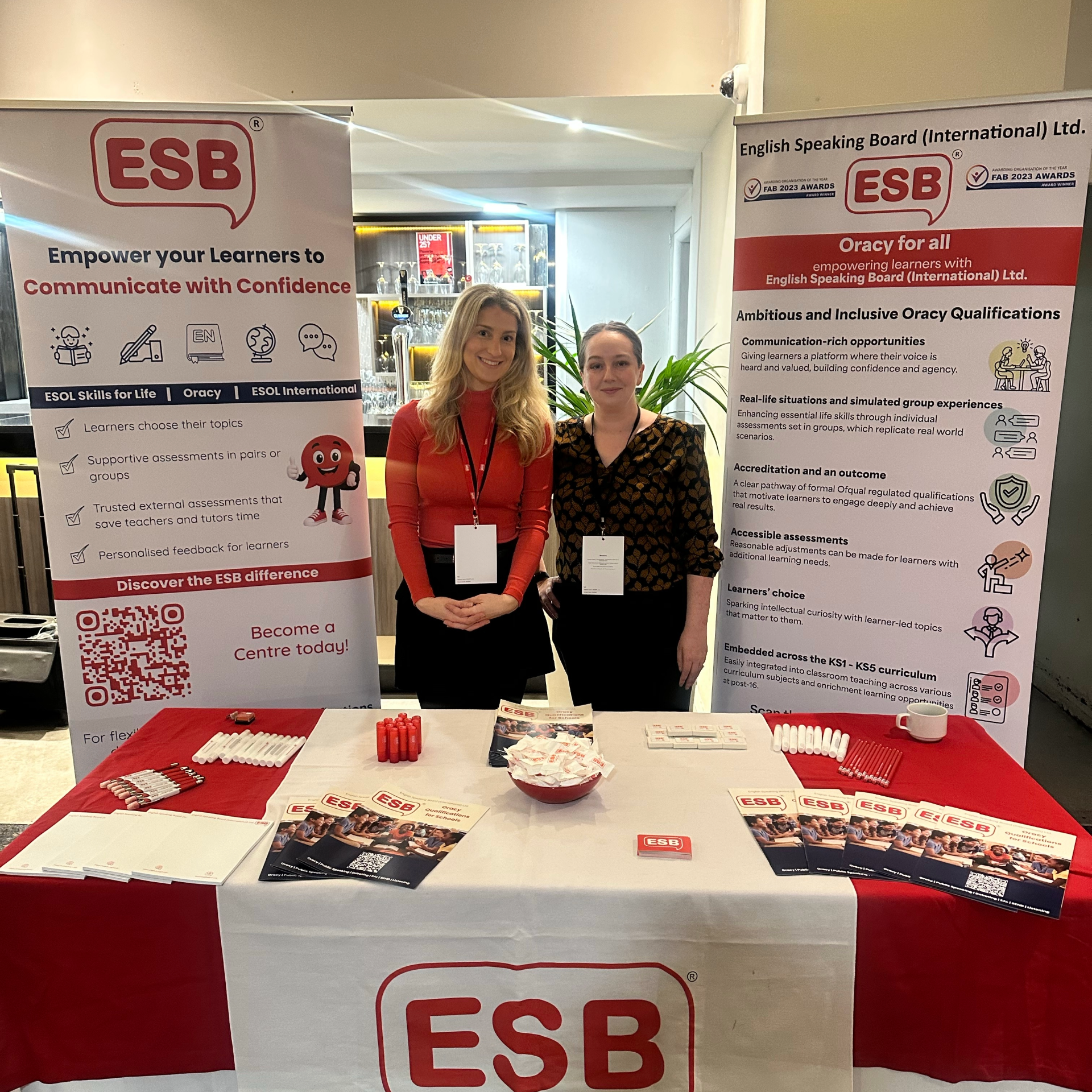
    Senior Customer Experience Officer, Georgie Anderson (left) and Senior Assessor for Oracy, Lauren Kearney (right) at The Great Oracy Exhibition 2026.

    ESB International was delighted to exhibit at The Great Oracy Exhibition on Wednesday 14 October, joining educators, school leaders and organisations from across the country to celebrate the importance of speaking and listening in education.


    Putting oracy at the heart of education

    For ESB International, it is incredibly encouraging to see oracy taking centre stage in the national education conversation.

    Speaking and listening underpin learning across the curriculum. Whether presenting ideas, contributing to discussions, debating different perspectives or preparing for employment, the ability to communicate confidently and effectively is a skill that learners will carry throughout their lives.

    As a specialist awarding organisation championing spoken communication since 1953, ESB International is proud to be part of the wider movement advocating for greater recognition of oracy in education.

    Our position is simple: if speaking and listening are fundamental skills, they deserve to be assessed and recognised just like reading, writing and other core areas of learning.

    Why assessing oracy matters

    Teaching oracy is essential, but we believe that meaningful assessment and recognition are equally important.

    Just as schools assess progress in literacy and numeracy, assessing speaking and listening provides an opportunity to recognise learners’ achievements, identify areas for development and demonstrate progression over time.

    ESB International’s qualifications provide a structured approach to developing and recognising these skills, with most of its oracy qualifications benefiting from independent external assessment by trained and standardised assessors.

    This approach allows schools to:

    • Recognise achievement: Give learners meaningful recognition for their speaking and listening skills.
    • Demonstrate progression: Provide tangible evidence of communication skills developing over time.
    • Celebrate every learner’s voice: Recognise different forms of communication and provide opportunities for learners with diverse needs to succeed.
    • Support teachers: Benefit from professional assessment and personalised feedback without adding unnecessary pressure to teaching workloads.

    Assessment should not simply measure what learners can do. It should also give them the confidence, motivation and recognition to continue developing their voice.


    Supporting schools at every stage

    Throughout The Great Oracy Exhibition, we were proud to showcase our portfolio of oracy qualifications, supporting learners from Early Years through to secondary, post-16 and specialist SEND settings.

    Our qualifications are designed to complement existing teaching and can be embedded across the curriculum, delivered through dedicated oracy units or incorporated into enrichment and extracurricular activities.

    We were also pleased to promote My Voice, our new suite of primary oracy qualifications. Designed to make the assessment and recognition of speaking and listening more accessible, My Voice allows trained school staff to assess learners through everyday classroom activities, with external moderation provided by ESB International.

    Together with our established qualifications in speech, debating and employability, this provides schools with flexible pathways for helping learners develop and demonstrate their communication skills.


    Discover how ESB International can support your school

    The Great Oracy Exhibition was an important reminder of the enthusiasm, expertise and commitment that exists across the education sector to strengthen oracy provision.

    We are thrilled to see speaking and listening receiving the attention they deserve and look forward to continuing our work alongside educators, partners and organisations, including Voice 21, who share our ambition to ensure every learner has the opportunity to be heard.

    As the conversation around oracy continues to grow, ESB International will continue to champion the importance of not only teaching these essential skills, but assessing, recognising and celebrating them.

    Thank you once again to Voice 21 and everyone who contributed to such an inspiring event.
  • ESB International heads to Bett Asia as it looks to strengthen partnerships across Asia

    ESB International heads to Bett Asia as it looks to strengthen partnerships across Asia

    ESB International heads to Bett Asia as it looks to strengthen partnerships across Asia

    ESB is attending Bett Asia graphic

    Building partnerships across Asia

    Over the coming year, ESB International is keen to connect with more international schools, education groups and partners across Asia that share its belief in the importance of confident and authentic communication.

    The Singapore Roadshow has been designed to strengthen existing relationships, develop new partnerships and explore how schools can support learners through oracy, public speaking, debating, enrichment and English language development. Adrian’s visit to Bett Asia creates an opportunity to extend those conversations beyond Singapore and meet education leaders from across the wider region.

    This matters because the role of spoken communication extends far beyond a single subject or activity. Whether learners are explaining an idea in science, contributing to a group discussion, presenting research, debating a topical issue or preparing for university and employment, the ability to communicate clearly and listen effectively supports participation across school life.


    Our Singapore Roadshow is about listening to schools, understanding what they want for their learners and exploring where ESB International can add genuine value. Bett Asia gives us the chance to broaden that conversation and meet educators and potential partners from across the region.

    As our international oracy work grows, we want to build long-term partnerships with schools that recognise communication as an important part of preparing young people for the future.

    Adrian Gallagher, Chief Executive of ESB International

    Where can oracy fit within an international school

    One of the strengths of our unique oracy qualifications is their flexibility.

    Schools can embed oracy into the core curriculum, using qualification activities alongside existing classroom learning, or offer qualifications through the co-curriculum, including enrichment, debating, public speaking and wider learner development programmes.

    ESB International’s qualifications are designed to complement learning across different subject areas rather than confining speaking and listening to the English classroom. Learners might research and present a curriculum topic, interpret literature, construct and defend an argument, respond to questions or engage with their peers through structured discussion.

    For international schools, that creates several practical opportunities.


    Structured progression in communication skills

    We offer oracy qualifications from early years and primary education through secondary and post-16. As learners progress, they can move from developing early confidence and expression to more sophisticated presentation, debating, critical thinking and evidence-led communication. Our Level 3 qualifications also carry UCAS Tariff Points, providing additional relevance for learners considering higher education in the UK.

    Authentic speaking and listening experiences

    Our oracy assessments take place in small, supportive groups, while learners are assessed individually. This creates opportunities for speaking, listening and responding that more closely reflect real communication, while encouraging collaboration and engagement with others.

    Learner choice and
    agency

    Learners are given meaningful opportunities to choose what they speak about, including topics, texts and areas that reflect their interests. Learners can also choose from four unique pathways at Level 1 and Level 2 that personalise their experience even further.

    In person or remote
    assessment options

    Assessments are delivered and marked by trained and standardised assessors, either in-person or online. Every learner who successfully passes their ESB assessment will be sent a physical certificate.

    Independent recognition
    of achievement

    Our oracy qualifications are externally assessed. Assessments are delivered and marked by trained and standardised assessors, giving schools an independent framework through which to recognise learners’ communication skills. Our qualifications at Level 1 and above are accredited by Ofqual.

    Specialist qualifications for learners with SEND or EAL

    We believe in oracy for all, and offer accredited qualification options for learners with SEND or EAL that offer those learners more accessible opportunities to engage with their oracy skills alongside their peers.


    Starting a wider conversation

    ESB International has championed confident communication for more than 70 years. As its work with international schools develops, the organisation is looking forward to learning from educators across Asia and exploring how its qualifications can complement different curricula, school cultures and learner priorities.

    Bett Asia is an important opportunity to continue that conversation.

    If you are attending Bett Asia on 23 September and would like to meet Adrian Gallagher to discuss oracy, public speaking, debating, EAL or opportunities to work in partnership with ESB International, get in touch with the team to arrange a conversation in Kuala Lumpur.

  • English Speaking Opportunities with ESB International and the English-Speaking Union

    English Speaking Opportunities with ESB International and the English-Speaking Union

    English Speaking Opportunities with ESB International and the English-Speaking Union

    At English Speaking Board (International) Ltd. (ESB International), developing confident communicators is about much more than one assessment. ESB International’s oracy qualifications give learners structured opportunities to find their voice, express ideas with confidence, listen and respond thoughtfully, and take ownership of what they want to communicate. Across its pathways, learners can develop skills in areas including speech, discussion, presentation and debating, with progression available from the early years through to post-16 education.

    And those skills do not need to stop when a learner receives their certificate.

    ESB International is pleased to be working with the English-Speaking Union (ESU) to highlight its national competitions for the 2026–27 academic year. For schools already delivering ESB International qualifications, they offer an exciting opportunity for learners to take the skills they have been developing and apply them in a new setting.

    For schools considering how to create more purposeful opportunities for speaking and listening, the competitions also demonstrate just how varied oracy can be, from constructing an argument to addressing an audience or interpreting a piece of literature.

    Three opportunities to take communication skills further

    Building the skills first

    Competitions provide a valuable opportunity to demonstrate communication skills, but confidence is built through regular opportunities to practise, reflect and progress.

    That is where ESB International’s qualifications can support schools.

    Its learner-centred approach gives individuals meaningful choices about topics, texts and discussion points, helping them take greater ownership of their communication. At secondary level, ESB International also offers dedicated Debating qualifications, where learners develop their ability to construct arguments, respond to different viewpoints, work collaboratively and communicate with increasing independence.

    For an existing ESB International learner, an ESU competition could therefore provide an engaging opportunity to take those skills into a different environment. Alternatively, learners who have already competed in an ESU competition, an ESB International oracy qualification is a natural next step for learners looking to achieve a recognised qualification for skills they have already demonstrated to a high level.

    Registration closes 16 September

    Registration for all three ESU competitions closes on Wednesday 16 September 2026. Schools and educational institutions across England and Wales can find competition information and registration details on the ESU website.

    ESB International is continuing to explore further collaborative opportunities with the English-Speaking Union, so watch this space for what comes next.

  • ESB Launches My Voice: New Oracy Qualifications for Primary Schools

    ESB Launches My Voice: New Oracy Qualifications for Primary Schools

    ESB Launches My Voice: A New Way to Recognise and Develop Oracy in Primary Schools

    Speaking and listening are at the heart of learning, helping children explore ideas, build relationships and develop confidence. Yet while reading and writing are routinely assessed and celebrated, spoken communication often receives less formal recognition in schools.

    That is why ESB International is proud to launch My Voice, a new suite of primary oracy qualifications designed to give schools a structured, practical and affordable way to recognise learners’ spoken language skills

    What is My Voice?

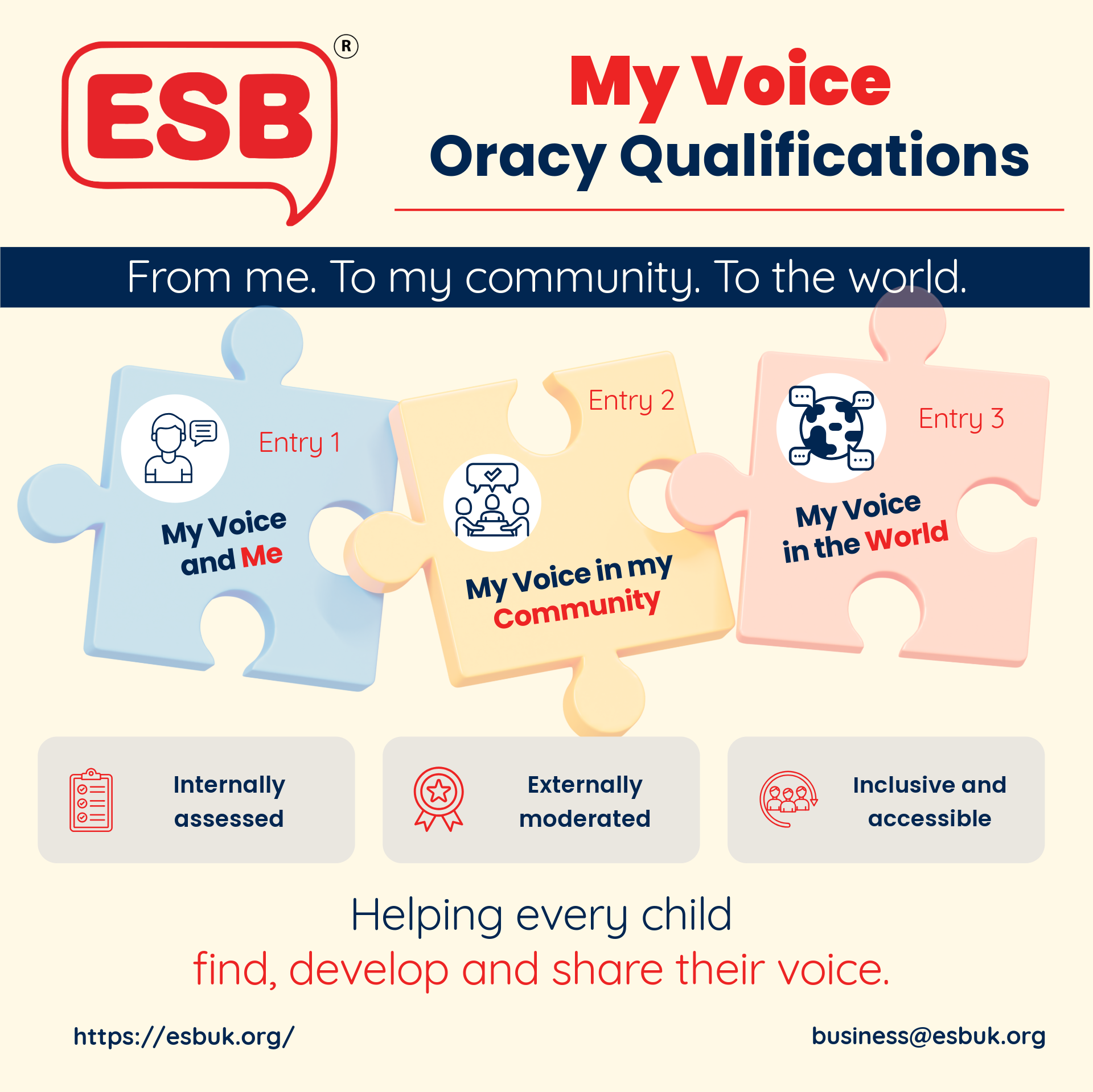
    My Voice is a suite of three unregulated oracy qualifications for primary-aged learners. The qualifications have been developed to help children communicate with confidence, listen actively, express ideas clearly and collaborate effectively with others.

    The suite consists of:

    ESB Oracy Award
    (Entry 1): My Voice and Me

    Young learner sat at desk raising hand

    Designed primarily for Key Stage 1 learners aged 5-7, this qualification develops foundational speaking, listening, storytelling and communication skills

    ESB Oracy Award
    (Entry 2): My Voice in My Community

    Diverse learners standing in a circle

    Learners develop greater independence through discussion, collaboration and communication linked to their communities

    ESB Oracy Award
    (Entry 3): My Voice in the World

    Cartoon globe with a smiley face

    Learners broaden their communication skills through discussion, debate and exploration of wider global themes


    Why Schools Need Oracy Qualifications

    Research and policy continue to highlight the importance of spoken language in supporting academic achievement, literacy development and personal growth. ESB’s new qualifications help schools:

    • Embed high-quality oracy practice
    • Recognise learners’ achievements in speaking and listening
    • Develop confidence and self-belief
    • Support literacy and comprehension
    • Encourage authentic communication rather than “test talk”

    Flexible Assessment for Busy Schools

    A key feature of My Voice is its practical classroom-based assessment model.

    Teachers assess learners through everyday activities including:

    • Presentations and talks
    • Collaborative discussions
    • Storytelling and reading aloud
    • Group problem-solving
    • Functional speaking and listening tasks

    Assessment is completed internally by trained staff and externally moderated by ESB International, providing confidence in outcomes while minimising disruption to teaching and learning.

    Affordable Oracy Recognition for every Learner

    Designed with flexibility in mind, the My Voice qualifications offer an accessible way for schools and educational providers to recognise and celebrate learners’ spoken communication skills. Whether delivered in a mainstream primary school, special school, alternative provision or community-based setting, the qualifications are designed to fit naturally within everyday teaching and learning. Their internally assessed model helps reduce barriers to participation while giving learners the opportunity to gain formal recognition for their oracy development.

    More Information Coming Soon

    Formal qualification specifications, teaching and learning resources, centre guidance and booking information will be released shortly. Registering your interest will ensure you are among the first to receive launch updates, qualification documentation and details on how to begin delivering the My Voice qualifications within your setting.