English Speaking Board (International) Ltd

Category: Oracy

  • Centre update 5: update for centres offering Speech assessments in summer 2020

    We are writing to you to update you about the Extraordinary Regulatory Framework that is in place for assessments that would have taken place between 20th March and 31st July 2020. We are still waiting for Ofqual’s final guidance, but we wanted to update you about what we know so far, taking into account your expressions of interest and communications with us in the last few weeks.

    What qualifications are going to be awarded on the basis of calculated grades?

    ESB International (Ltd) is going to use calculated centre assessments for ESOL Skills for Life and for qualifications for learners with Special Educational Needs and Disabilities.

    What assessments are going to be adapted?

    We propose to use adapted assessments for the following Speech qualifications:

    • ESB Level 1 Award in Speech (Grades 1, 2, 3)
    • ESB Level 2 Certificate in Speech (Grades 4, 5)
    • ESB Level 3 Certificate in Speech (Grade 6, 8)
    • ESB Level 3 Award in Travel and Tourism Oral Communication Skills for Overseas Resort Representatives
    • ESB Level 4 Award in Professional Presentation Skills
    • ESB Level 1, 2, 3 Awards in Using Oral Skills for Interviews
    • ESB Entry Level Award in Graded Examinations in Speech (Entry 1, 2, 3) (EAL-A1, A2, B1)
    • ESB Level 1, 2, 3 Awards in Debating
    • ESB Level 1 Award in Group Speaking
    • ESB Level 1 Award in Oral Skills for School Interviews

    Our aim is to support our centres so that as many learners as possible can take their assessments this term given the current situation. We will be contacting all of our centres after half term by phone to see how we can support you and your learners.

    What is adaptation going to look like?

    As a centre you need to consider which form of adaptation would allow your students to complete their assessment.
    We are considering three possible forms of adaptation:
    1) Asynchronous assessment where you film your learners performing their assessments, with a teacher acting as interlocutor and facilitating the interactive phase of the assessment, and you submit the videos to us for assessment. This would be for a situation when you and the learners can be at school together, but an external assessor is not permitted to come in. ESB would provide scripts and guidance for teachers acting as interlocutors.
    2) Synchronous assessment set up by the centre using video conferencing software, with all the participants and the assessor working remotely.
    3) Asynchronous assessment for more independent learners who are still based at home. This would include a calculated component for the interactive stages of the assessment when the learners are expected to demonstrate their listening skills. ESB would provide guidance for centres for filming and separate guidance for teachers to submit their calculated grade for the learners’ interactive skills

    The assessor will complete a report form as usual and results and certification will have the same value as the qualification taken under the usual Regulatory Framework.

    What guidance will there be?

    We will be providing guidance on:

    • how to facilitate and conduct your assessments
    • accommodating learners with special educational needs and disabilities
    • technical requirements such as filming, uploading video
    • guidance where teachers will need to submit calculated grades for learners interactive skills
    • additional documentation that you need to collect – consent forms, etc.

    What can centres do at the moment?

    You and your learners can start choosing your prepared texts, and preparing for the assessment. You can think about the dates for your assessment and which learners you will be registering, and you can book and register them in the usual way on our system. We do not anticipate the adapted assessments beginning
    before the middle of June.

    Our aim is to support our centres so that as many learners as possible can take their assessments this term given the current situation. We will be contacting all of our centres after half term by phone to see how we can support you and your learners.

    What if I have a question?
    Please send your questions to product@esbuk.org
  • ESB Launches New Speech Pathways

    We are delighted to announce that our ESB Level 2 Certificate in Speech (Grade 4) qualification has been updated and you can start booking today! The qualification now gives more options to explore oracy in the classroom. Learners can develop their oracy skills in a way that suits them, playing to their strengths and interests.

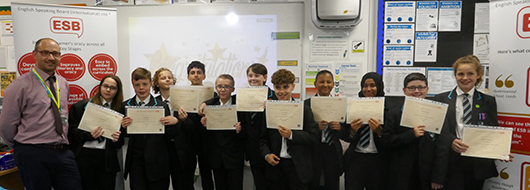
    Mr Carl Bennett with the learners of Ellis Guilford who participated in the 2019 ESB Level 2 Certificate in Speech (Grade 4) Pathways pilot.

    We have now implemented the following new Pathways to give greater flexibility to your learners – read about them below:

    ESB Logo

    What do Learners and Teachers think of our new Pathways…

    To put our new Pathways to the test, we piloted them in 10 centres with over 300 learners and the results were impressive! These Pathways retain our core values that makes ESB an enjoyable learning experience, but add a new format of assessment with new learning outcomes. For each Pathway, learners improved their oracy skills in almost every category.

    Improves Communication Skills

    Teachers observed that an overwhelming 50% of learners felt that their communication skills had improved after their Pathways qualification, and there was a 44% increase increase in the number of learners who felt they became more competent in delivering short speeches and presentations.

    Boosts Employability

    The Speech for Employability proved a great success with participating schools. 75% of learners left feeling their communications in mock employment scenarios were ‘good’ or ‘very good’ – a dramatic improvement on just the 25% who felt they were at this level before the qualification.

    Mapped to the National Curriculum

    Our Level 2 (Grade 4) Pathways are designed to match the National Curriculum requirements in Spoken English at Key Stage 3 and 4. Teachers from the participating schools saw a dramatic increase in learners achieving the following KS3 criteria: discussing language and meaning, expressing own ideas and high competency in using Standard English competently.

    Personal Development

    The Pathways help teachers deliver Personal, Social, Health and Economic (PSHE) education, as well as the promotion of citizenship and British values. They also contribute learners’ Spiritual, Moral, Social and Cultural (SMSC) development. The results prove that ESB qualifications benefit every learner, regardless of ability. In the Speech to Inform qualification, the number of learners who felt they had “bad” communication skills dropped by 50% after they had completed their assessment.

    ESB Logo
     

    • Curriculum for Wales – The Pathways allow learners to meet the Statutory Oracy Requirements at Key Stages 3 and 4.
    • The Irish Curriculum – The Pathways meet the statutory communication related requirements for Language and Literature (English and Media) and Skills and Capabilities at Key Stages 3 and 4.

    We’re really excited to give your learners’ even more choice. They are available to book now!

  • Celebrating success in Salford: ESB presents RECLAIM teens with well-earned qualifications.

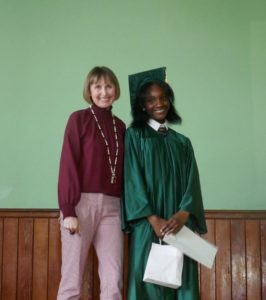
    If only all graduation ceremonies were as inspiring as this! Tina Renshaw, ESB Chief Executive, presented certificates to young learners from the Manchester-based charity RECLAIM to celebrate their fantastic achievement.

    Tina and two representatives from ESB followed in Morrissey’s footsteps up to the famous Salford Lads Club to congratulate the young learners on their completion of the Speech Pathways Pilot qualification, ‘Speech to Inform’. For the assessment, the learners are encouraged to review a current news item, give a persuasive talk about a topic that interests them and give a presentation about something they are passionate about.

    The youngsters, some of whom were initially afraid of standing up and speaking in front of their peers, chose topics ranging from climate change to feminism and all went on to pass their assessments.

    Said Tina, “I’m incredibly proud to meet the RECLAIM learners. These inspirational young women have now got a recognised qualification that proves they can speak clearly and with confidence.”

    By giving them a platform and an opportunity to get their voices heard, they can keep their heads held high, and with these skills under their belts, some of them may become leaders someday.


    The RECLAIM Graduates


    Katie Cosgrave, Alumni Lead at RECLAIM said after the event:

    After seeing the impact ESB has had on these young people, I feel it is incredibly important that we continue to do these qualifications here at RECLAIM. It demonstrates the clear need for oracy to be taught in schools as I truly believe communication is key to success, and I’m so proud to be a part of this pilot.


    To find out more about the work RECLAIM does for young working-class people, please visit their website: https://www.reclaim.org.uk/.

  • ESB welcomes the Oracy All-Party Parliamentary Group’s inquiry – Speak for Change.

    English Speaking Board (International) Ltd. is supporting a new parliamentary inquiry Speak for Change, led by Emma Hardy MP, which is paving the way to improve oracy education in schools.


    As a member of The Oracy Network, ESB is proud to be part of a movement championing the value of good speaking and listening skills and the need for oracy to be reflected in educational policy making and curriculum development.

    There is a rapidly growing recognition of the importance of teaching children and young people to speak effectively and with confidence, in order to aid their learning and prepare them for life beyond school.  The Speak for Change inquiry will investigate the current provision of oracy education in the UK, assess its value and impact, and identify the barriers teachers are facing in embedding and prioritising oracy in school.

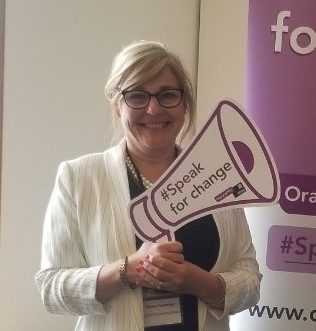
    An ESB team, led by Chief Examiner, Elaine Rudduck, attended the launch of the inquiry held in Parliament to speak to MPs and learners, and to meet with the Oracy Network to emphasise the importance of oracy for improving social mobility and job prospects for young people.

    Elaine Rudduck, Chief Examiner

    “Our qualifications develop confidence, improve communication skills, realise potential and recognise achievement with an accredited award, so we are incredibly proud to be part of the exciting conversations happening about oracy through The Oracy Network.” said Elaine.

    “It’s fantastic to see that oracy is starting to be recognised as a priority in education.”

    ESB’s primary objective is to promote clear communication across society – stretching the most able and supporting the least confident. Many of ESB’s Speech assessments are carried out in supportive listening groups, allow learners to choose study pathways which reflect their interests and strengths, and are designed to empower and support them as they find their voice. ESB shares the Oracy APPG’s vision to improve everyone’s ability to articulate their ideas, thereby creating greater opportunities for social mobility.

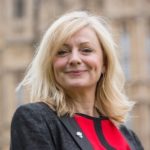
    One of the MPs at the launch was Tracy Brabin MP who said:

    Tracy Brabin MP

    I’ve seen first-hand the need for teaching oracy in schools. Many of the pupils in my Batley and Spen constituency have the academic skills but lack those key communication skills to help them progress, particularly as they apply to their chosen colleges or universities.


    MPs who are members of the Oracy APPG are calling on the education sector to have their say and submit evidence. The Oracy APPG need help to promote the inquiry to ensure they gather a wide range of views from across society and highlight how important oracy is for the next generation.

    A call for evidence is now open and the inquiry will welcome written and video submissions from across the education sector, industry and civil society. Most importantly, it will ensure the views of teachers, parents, children and young people are represented.

    If you feel passionately about oracy in your centre, or know someone in your network who does, please contact Deborah Bassett on deborah.bassett@esbuk.org to help spread the word and Speak for Change.