Category: Uncategorised

  • Reaching learners facing disadvantage

    English Speaking Board (International) celebrates its 70th Anniversary in 2023! To honour this special milestone, we are launching a significant outreach campaign that will make access to our suite of speech and language qualifications more available to groups and organisations which are seeking to close the disadvantage gap. We hope to support organisations where their learners face disadvantage due to socio economic factors, disability or migration status. We will support them financially to access our assessments, support and training.

    ESB learners from Heygreen Primary School

    English Speaking Board continues to prepare today’s learner for tomorrow’s world through its assessments – particularly reaching out to those learners facing disadvantage!

    ESB is removing barriers to learning by supporting disadvantaged learners from schools within the Rainbow Education Multi-Academy Trust to access its assessments as part of its 70/70 Campaign!

    Established to provide the best possible education to children across the Merseyside City Region, the Rainbow MAT consists of a group of innovative schools where their young people face disadvantage, and who all share a common mission similar to that of ESB, to ‘inspire children to grow up and have a positive impact on their world’.

    ESB has already successfully enabled learners at one of the Trust’s schools, Heygreen Primary School, access to its qualifications.

    With many learners facing disadvantage due to socio-economic factors, disability and migration status, the proportion of disadvantaged pupils at Heygreen Primary School is well above the national average as is the proportion of pupils from ethnic minority groups and those who speak English as an additional language. Learners identified as having Special Educational needs and/or learning disabilities is also higher than average.

    ESB’s assessments are part of the growing range of school-wide activities that the Trust provides which help to support the broader development of their learners’ English Language skills and which help to improve their outcomes.

    Research from Sutton Trust in February 2019, for the APPG for Social Mobility, found that from the age of five, the UK’s most disadvantaged children can be 19 months behind their more affluent peers in vocabulary development, and this deficit can have life-long consequences. By not developing our children’s language and communication skills from the earliest opportunity, we are limiting our workforce and the economy.

    With the above in mind, improving the life chances of all children to reach their maximum potential and inspiring high-quality communication in people is something ESB and the Rainbow MAT recognise, with both parties being engaged in the value of oracy as a vehicle for social mobility.

    ESB’s Chief Executive, Tina Renshaw and ESB’s Communications Team visited the school during the preparation of the learners’ assessments to gain a clearer insight into their ESB experience. Watch the video below capturing highlights from our visit:

    Class teacher, Andrea Beed expressed her thoughts on teaching ESB and the subsequent positive impact it has had on her pupils. “As a teacher, it’s my goal to help all learners reach their potential and effective communication skills are important in every aspect of life. ESB has given my pupils that focus and something to work towards.”

    Adds Nicola Rutter, Head Teacher of Heygreen Primary School, “Last year, we launched our partnership with ESB with a small group of learners from Y6. This was through the running of a small lunchtime group that we called ‘Star Speakers’. This group was run by our oracy lead, Andrea Beed. As a result of this group’s participation in the Speech assessment, we identified that the impact on their speaking skills, self-esteem and independent learning was significant and, as a result, we are now furthering our partnership with ESB with our Y4 and Y5 classes. Y4 will take part in the Group Speaking assessment and Y5 will be assessed, individually, in the Speech assessment. The children and staff are extremely excited to incorporate the ESB assessments into our KS2 Spoken Language curriculum. We really believe in the value of this partnership, as it is supporting our pupils in developing a range of skills; helping to prepare them for the next stage of their education. “

    Says Tina, “I am delighted to join forces with the Trust, enabling more disadvantaged learners to get their voices heard. Here at ESB, the learner is not a performer of studied pieces, but a person taking their place in society as a worker, a citizen. We do not only assess what the young person knows or says, but what they have become. We are passionate about closing the disadvantage gap.”

    Read about what some of the learners at Heygreen had to say about their ESB experience!

    ‘’I used to be very shy, but when I started ESB it helped me get up in front of people and talk about things that I’ve never been able to talk about”.

    “The more you speak, the more confident you feel”.

    “We have enjoyed ESB a lot because it has helped boost our confidence!”

    The Rainbow MAT is one of our groups that is using ESB to further its cause, but ESB would like to help many more.

    If you are interested in finding out whether your centre is eligible for funding and wish to know the options available to you, please email business@esbuk.org.

    If you believe your learners or young people would benefit from ESB assessments, we would love to hear from you!

    For further details about our 70/70 Campaign, please click here.
  • ESB Learners celebrate success!

    ESB learners’ achievements were honoured at a recent Awards ceremony!

    New City College in East London held its annual Student Achievement Awards Ceremony in recognition of the success of its high achieving students.

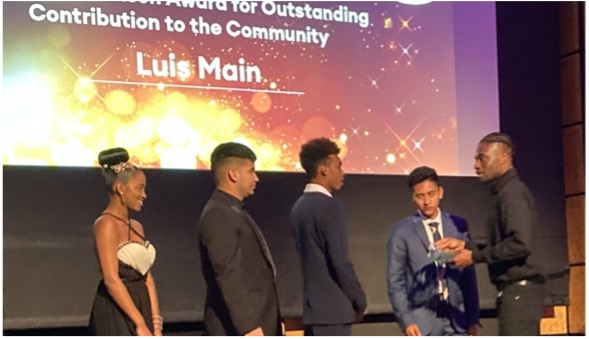
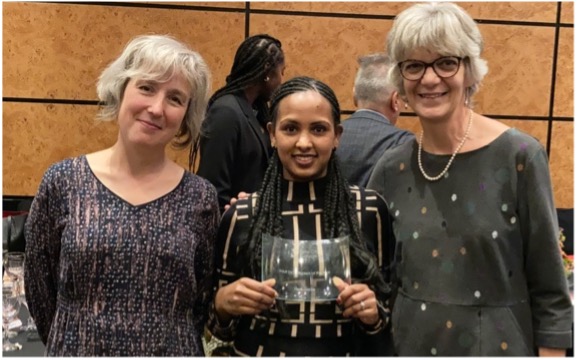
    Five awe-inspiring learners were each presented with awards, including Adult ESOL Student of the Year, Young ESOL Student of the Year and the Ray Wilkinson Award for Outstanding contribution to the Community after completing ESB’s ESOL Skills for Life assessments. ESB’s Product Development Manager, Anthea Wilson, was delighted to be in attendance to witness the event.

    Also joining the celebrations was special guest, former New City College student, Charles Babalola, who was responsible for presenting the awards. Having received the Alan Bates Award for graduating actors, Charles is best known for the films The Legend of Tarzan, Mary Magdalene, and the latest, Gretel & Hanzel. 

    Receiving accolades were the following ESB learners:

    Adult ESOL Student of the Year Award: Nielti Gebre
    Young ESOL Student of the Year Award: Yousif Burhan
    Ray Wilkinson Award for Outstanding Contribution to the Community: Francia Rafalason, Francois Rafalason and Luis Main


    Says Anthea, “I was honoured to celebrate the achievements of these exceptional ESB ESOL learners. It was fantastic to see so many inspiring young people being recognised for overcoming challenges through their hard work and resilience. Congratulations to all learners!”

    ESB’s Chief Executive, Tina Renshaw, adds, “We feel very privileged to celebrate the achievements of these students. ESOL Skills for Life are qualifications designed for those who live study or work in the UK and we recognise the incredible obstacles some student have to overcome to become successful. They should be very proud of themselves!”

    ESB’s ESOL assessments facilitate language development to help learners obtain the vital skills that support engagement in daily life activities, develop further learning and independence, and gain or progress to meaningful and sustainable employment. Its assessments enable learners to become competent in core language skills; reading, writing and speaking and listening. 

    For further information about our ESOL Skills for Life assessments, please click here. Alternatively, if you still have unanswered questions or you would like to become an ESB centre, please contact our Business Development Team. We’d love to hear from you.

    Let the ESB experience enrich your learners’ lives and give them the opportunity to shine!

  • ESB News Autumn/Winter Edition 2021

    Please click here to read our Autumn/Winter Edition of ESB News:
    ESB News Autumn/Winter Edition

  • ESOL International qualifications – opportunities for ESOL learners following Brexit

    Tes.com, the global education organisation supporting teachers and educational organisations around the world, recently published an article highlighting the need for a new ESOL strategy following Brexit, which could, with the support of ESB International, provide opportunities for your ESOL learners to further develop their English language skills.

    If your learners are progressing from ESOL Skills for Life qualifications at Entry 3, Level 1 or Level 2, ESB has an ESOL International qualification suitable for them.

    English Speaking Board (International) Ltd. offers four Ofqual-regulated ESOL International qualifications at B1, B2, C1 and C2 on the Common European Framework of Reference (CEFR). The CEFR is used all over Europe and internationally as a framework for learning, teaching and assessment.

    These four qualifications are suitable for learners who wish to improve their level of general English for personal, academic or professional reasons, and achieve a high-quality, internationally recognised qualification at the CEFR level appropriate to them and their educational circumstances.

    CEFR Levels B1-C2 and mini tests

    ESOL Skills for Life and ESOL International assessments differ, therefore there is not necessarily a direct progression that is the same for every learner. Please read the information below and encourage your learners to try out our mini-tests to see which test is the most appropriate level!

    I have completed:You should try:
    ESOL Skills for Life Entry 3ESOL International B1 or B2
    ESOL Skills for Life Level 1ESOL International B2 or C1
    ESOL Skills for Life Level 2ESOL International C1 or C2

    ESB Entry Level Certificate in ESOL International All Modes (Entry 3) (B1)
    B1 learners can produce simple connected text on topics which are familiar or of personal interest; describe experiences and events, dreams, hopes and ambitions and briefly give reasons and explanations for opinions and plans*.

    If learners have achieved ESOL Skills for Life Entry 3 or Level 1 Speaking & Listening, Reading and Writing Awards, then they should try this B1 mini sample assessment here.

    ESB Level 1 Certificate in ESOL International All Modes (B2)
    B2 learners can produce clear, detailed text on a wide range of subjects and explain a viewpoint on a topical issue giving the advantages and disadvantages of various options*.

    If learners have achieved ESOL Skills for Life Entry 3 or Level 1 Speaking & Listening, Reading and Writing Awards, then they should try this B2 mini sample assessment here.

    ESB Level 2 Certificate in ESOL International All Modes (C1)
    C1 learners can use language flexibly and effectively for social, academic and professional purposes, and produce clear, well-structured, detailed text on complex subjects, showing controlled use of organisational patterns, connectors and cohesive devices.*

    If learners have achieved ESOL Skills for Life Level 1 or Level 2 Speaking & Listening, Reading and Writing Awards, then they should try this C1 mini sample assessment here.

    ESB Level 3 Certificate in ESOL International All Modes (C2)
    C2 learners can understand with ease virtually everything heard or read and express themselves spontaneously, very fluently and precisely, differentiating finer shades of meaning even in more complex situations.*

    If learners have achieved ESOL Skills for Life Level 2 Speaking & Listening, Reading and Writing Awards, then they should try this C2 mini sample assessment here.

    Features of the ESOL International qualifications

    • They are appropriate for teenagers and adults.
    • They encourage progression and measure learners’ attainment as they move through the CEFR levels on their learning journey.
    • There are five sections: Listening, Reading, Use of English and Writing are tested in one written paper, and there is a Speaking assessment taken in pairs.
    • Each section is worth 20% of the final mark, i.e. the final mark is a combination of four skills and Use of English.
    • All the sections are available online and can be completed in the learner’s home or in centre based IT facilities.
    • The Listening, Reading and Use of English sections are tested through multiple choice questions.
    • There are three Pass grades – Pass, Merit and Distinction.
    • ESB Level 3 Certificate in ESOL International All Modes (C2) carries UCAS points – 12 for a Pass, 24 for Merit and 36 for a Distinction.
    • Speaking assessments are taken in pairs, with an assessor and an interlocutor.
    • Marking and assessing is by ESB International and subject to ESB International quality assurance processes.

    *Table 1. Common Reference Levels: global scale in Council of Europe. (2001). Common European framework of reference for languages: Learning, teaching, assessment. Cambridge, U.K: Press Syndicate of the University of Cambridge, p.24.

    For more information on ESB International ESOL International qualifications please contact busdev@esbuk.org.