Author: Liam Morton

  • ESB wishes its centres and learners a Happy Easter!

    ESB would like to wish its centres and learners a happy, healthy and heart-warming Easter break.

    The offices of English Speaking Board (International) Ltd. will be closed from Thursday 14th April and will re-open on Tuesday 19th April, 2022. All queries will be answered as soon as we return.

    ESB celebrates its 70th Anniversary in 2023!

    2023 marks the 70th Anniversary of ESB. This important milestone is being celebrated through ESB’s 70/70 campaign that aims to reach out to more organisations where children, young people and adults face disadvantage. The 70/70 campaign supports organisations financially to access its wide range of speech and language assessments.If you believe your learners or young people would benefit from developing key speaking and listening skills, we would love to hear from you! Please email business@esbuk.org to find out whether your centre is eligible for funding and support.

    ESB thanks its centres for its continued support.

    Best wishes,
    The ESB Team

  • ESB empowers learners to succeed through its speech qualifications

    ESB updates and improves its Entry Level Award Graded Examinations in Speech (EAL) qualification specifications.

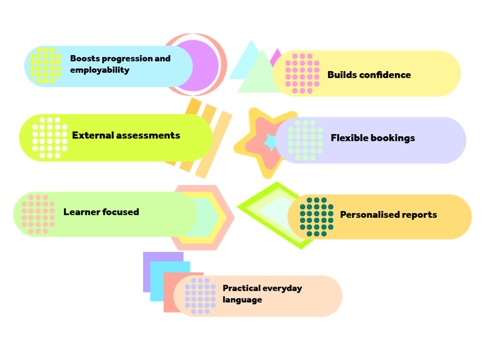
    Designed for learners who speak English as an additional language, ESB’s Graded Examinations in Speech (EAL) qualifications enable individuals to flourish in their ability to communicate with confidence – equipping them with the tools needed to thrive in education, training and employment.

    Learners can develop their confidence and interactional competence as well as their speaking, reading and listening skills through ESB’s Ofqual accredited qualifications.

    ESB’s Product Development Manager, Anthea Wilson says, “Updating the specifications for these qualifications has really highlighted what an exciting opportunity they are for our learners whose mother tongue is not English and who would benefit from developing confidence by working on their speaking and listening skills. At ESB International, we stretch the most able and support the least confident, and using these Speech EAL qualifications alongside or instead of the Awards in Speech mean that all our learners can achieve their full potential.”

    We encourage you to consider these qualifications for your learners if you are looking for assessments that:

    • promote oracy
    • help learners to use their voice effectively
    • accommodate the linguistic development of English language learners
    • support progression onto the mainstream school curricula
    • enrich cultural capital
    • are mapped to the National Curriculum in England in relation to its requirements in Spoken Language and Reading at Key Stages 1 and 2
    • reference the descriptions of language proficiency at A1, A2 and B1 in the Common European Framework Reference for Languages (CEFR)
    • foster collaborative working.

    The revised specifications include details about:

    • how to use the ESB Entry Level Awards in Graded Examinations in Speech (EAL) at A1, A2 and B1 in combination with the Awards in Speech
    • coverage of the National Curriculum in England
    • CEFR coverage of communicative language activities and strategies for young learners at A1, A2 and B1
    • assessment and grading
    • ESB International assessment rationales and outcomes.

    Please see the list of updated specifications below:

    ESB Entry Level Award in Graded Examinations in Speech (Entry 1) (EAL-A1)
    Target learner group is Year 3 – £30.00 per learner.

    ESB Entry Level Award in Graded Examinations in Speech (Entry 2) (EAL-A2)
    Target learner group is Year 4 – £31.00 per learner.

    ESB Entry Level Award in Graded Examinations in Speech (Entry 3) (EAL-B1)
    Target learner group is Year 5 – £32.00 per learner.

    Can you combine ESB’s Entry Level Awards in Graded Examinations in Speech EAL with ESB’s Graded Examinations in Speech to suit learners’ needs?

    Yes, the structure of the ESB Entry Level Awards in Graded Examinations in Speech EAL qualifications allows learners to be assessed in a group of six, alongside learners entered for the ESB Graded Examinations in Speech. The diagram below shows recommended combinations based on the content of the assessment and the timing per learner.

    ESB celebrates its 70th Anniversary in 2023!

    As demonstrated through its 70/70 campaign, ESB is passionate about closing the disadvantage gap. Steadfast in its determination to reduce the impacts of disadvantage on speaking and listening skills, it wants to reach schools where learners facing disadvantage due to socio-economic factors, special educational needs and disabilities, and/or migration status and enable them to embed Oracy education and access its qualifications.

    If you believe your learners or young people would benefit from an Oracy journey which includes ESB assessments, we would love to hear from you! Please email business@esbuk.org to find out whether your centre is eligible for funding and support.

  • ESB celebrates Neurodiversity Week!

    Since its inception almost 70 years ago, ESB’s never-diminishing focus and mission to unlock learners’ potential – to stretch the most able, support the least confident and close the disadvantage gap – is more poignant than ever as we celebrate Neurodiversity Week!

    ESB’s Chief Executive, Tina Renshaw with ESB learners at Belfast Metropolitan College

    According to the Department of Education in England, 15% of students in the United Kingdom have a learning difference.

    Founded in 2018 by Siena Castellon, an advocate for autism acceptance and neurodiversity in schools and the workplace, Neurodiversity Celebration Week celebrates people with learning differences.

    The initiative aims to encourage educators to recognise the strengths and talents of neurodivergent learners and aims to educate teachers on how to identify and support them. Despite the significant percentage of students being neurodiverse, in England, teachers often do not feel sufficiently trained to provide a curriculum where the needs of neurodiverse learners are met.

    Parallel to Siena’s vision – to educate and foster supportive environments for the neurodivergent, and to change the way they are perceived and supported – is ESB’s vision, reflected in its dedication to embrace inclusivity and to empower all its learners, through its assessments, to achieve their potential.

    “By celebrating the strengths of neurodivergent individuals, we can begin the seismic shift of changing the way neurodivergent individuals are perceived and supported, empowering them to achieve their potential”. Siena Castellon

    ESB’s long-term commitment to supporting neurodivergent learners is demonstrated by its unique Speech portfolio of qualifications for learners with significant special educational needs and disabilities. By enabling its learners to develop key oracy and communication skills, ESB’s Speech assessments enable learners with special educational needs and disabilities to develop a sense of belonging, encouraging autonomy, as well as facilitating the fulfilment of potential.

    Speaking at the Oracy APPG launch in April 2018 about his perspective on social mobility as a learner with Asperger’s, one of ESB’s Ambassadors commented that although recognising that like many people who live with Asperger’s he had good language skills, he felt that oracy training enhanced his communication skills. He recounted:

    I wanted social communication but didn’t know how to go about getting it. That changed in Year 4 when I found ESB, which was so beneficial to me. It helped me with presenting skills, it helped me with eye contact which I used to struggle with a lot, it also showed me how to interact with people. It also helped me to listen to people, I didn’t know how to see things from other people’s perspectives but talking to people and learning to understand them was brilliant. I also experienced an unparalleled sense of achievement with every qualification I got, which boosted my confidence even more. Oracy Skills, developed from an early age can help bridge the social mobility gap for people like me, with disabilities such as Autism.

    Tina Renshaw ESB’s Chief Executive, says:

    We all want to be seen, be heard and understood, and for our strengths to be appreciated and for barriers to learning to be removed. ESB’s purpose to positively impact and provide inclusivity and the same opportunities for learners with significant learning disabilities is part of a wider campaign – its 70/70 Campaign. ESB aims to reach out to disadvantaged learners (those facing disadvantage from socio-economic factors, migration, and special educational needs and disabilities) and will support their schools, colleges and organisations financially to access its assessments, support and training. ESB’s trainers share with teachers classroom activities to build oracy skills and knowledge as well as guiding teachers to understand the levels of performance and its assessment criteria.

    Neurodiversity Celebration Week is about promoting acceptance, tolerance, and understanding of difference. With its work and through its 70/70 Campaign, ESB endeavours to ensure that every learner reaches their full potential and embraces their unique super power!

    If you are interested in our refreshed portfolio of Speech qualifications for learners with special educational needs and disabilities, we would love to hear from you! Please contact a member of our Business Development Team at business@esbuk.org for further information.

  • The importance of Oracy Education to tackle educational inequality: ESB endorses the views of MP and Chair of the All-Party Parliamentary Group on School Exclusions

    “We must ensure oracy is at the heart of our approach to tackle educational inequality for children, and crucially, to level the playing field later in life”, says Andy Carter.

    Andy Carter, Conservative MP for Warrington South and Chair of the APPG on School Exclusions has recently published an article emphasising the importance of Oracy Education to tackle educational inequality.

    The article emphasises the worsening spoken language gap that exists between disadvantaged pupils and their peers as a result of Covid – highlighting that Oracy education has never been more important. This position echoes that of the Speak for Change Inquiry by the Oracy APPG, which published its report in April 2021.

    “It is critical, now more than ever, that oracy is fully embraced by schools as a key tool for levelling up opportunities for working class kids, equipping them with the vital skills needed to advance into further and higher education, and join the labour market.”

    Says ESB’s Chief Executive, Tina Renshaw, “As a member of the Oracy Network, the group supporting the work of the Oracy APPG chaired by Emma Hardy MP for Kingston upon Hull West and Hessle, ESB has been successfully offering oracy qualifications to learners for nearly 70 years and knows its impact as a valid pathway to promote oracy in schools. Research from Sutton Trust in February 2019, for the APPG for Social Mobility, found that from the age of five, the UK’s most disadvantaged children can be 19 months behind their more affluent peers in vocabulary development, and this deficit can have life-long consequences. By not developing our children’s language and communication skills from the earliest opportunity, we are limiting our workforce and the economy. The report states: ‘Children with poor vocabulary aged five are more than twice as likely to be unemployed aged 34’.”

    “Clarity of communication and an ability to express thoughts simply, sincerely and persuasively, are qualities needed by everyone in this specialised, competitive world.  For whatever the industrial, professional or social responsibilities are, every individual will have to inform, instruct, listen, explain, question, interpret, disagree and advise. ESB’s assessment frameworks can act as a scaffolding tool for embedding Oracy into a school curriculum”.

    One of the young people from the Reclaim Project, a youth social justice charity supported by ESB said this of the impact of Oracy skills, “As someone from one of the most marginalised groups in the country I believe that it is even more important that the children and young people from marginalised groups have a voice, and one that is going to allow them to have a place in the world. One that is going to allow them to create better opportunities for themselves in education and in the world of work and self-employment. Good oracy empowers children, young people and their teachers to communicate more effectively. The benefits of this are tremendous.”

    “Teachers across primary and secondary schools must be given much greater oracy training and support”.

    The recommendations of the Oracy APPG inquiry supported this position, with recommendations for the DfE, Ofsted, teacher trainers, schools leaders as well as Ofqual. The suggested steps for the Department for Education included publishing non-statutory guidance (like the Gatsby Benchmarks or Model music curriculum) for how schools can embed the statutory spoken language requirements set out in the National Curriculum. This non-statutory guidance was to include evidence on effective approaches to oracy – Clear expectations for oracy teaching and learning accompanied by a learning progression building on  existing frameworks such as those developed by a number of Oracy organisations including ESB.

    “Half of teachers across primary and secondary schools said school closures negatively impacted the spoken language development of free school meal pupils, just one in five said the same of the most affluent pupils.”

    As demonstrated through its 70/70 campaign, ESB is passionate about closing the disadvantage gap. Steadfast in its determination to reduce the impacts of disadvantage on speaking and listening skills, it wants to reach schools where learners facing disadvantage due to socio-economic factors, special educational needs and disabilities, and/or migration status and enable them to embed Oracy education and access its qualifications.

    Did you know?

    • The majority of ESB’s Speech Qualifications are Accredited.

    • ESB’s Level 3 Graded Examinations in Speech qualifications and our Level 3 Debating qualification carry UCAS tariff points for university and HE entry.

    External funding options may be available for your learners. Your centre may also be eligible for funding and support through our Christabel Burniston Fund.


    If you believe your learners or young people would benefit from an Oracy journey which includes ESB assessments, we would love to hear from you! Get in touch and find out whether your centre is eligible for funding and support. Please email business@esbuk.org

    You can also read the full article here: https://www.politicshome.com/thehouse/article/spoken-language-support-for-children-is-crucial-to-tackle-educational-inequality.